
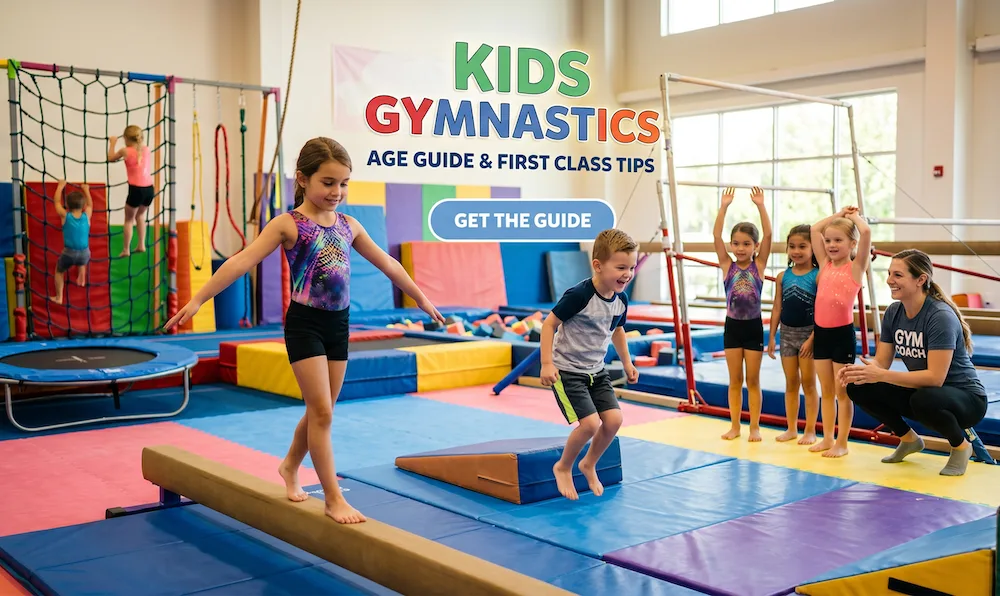
Gymnastics for kids in Sydney is one of the most searched activity topics among parents — and one of the most misunderstood. Parents hold off for years, convinced their child needs to be older, more coordinated, or naturally flexible before walking into a gym. Others enrol a two-year-old expecting cartwheels by week three. Both groups walk away confused.
The reality is more straightforward and more interesting. Gymnastics is one of the most developmentally rich activities available to children aged 2 through 12. A randomised controlled trial published via the National Institutes of Health (2024) followed 300 preschool children through a 36-week structured gymnastics program and found significant improvements in both locomotor skills and object control — the two cornerstones of physical literacy. Two sessions per week was enough to produce these outcomes.
This guide is built for parents who want to move past vague answers. By the time you finish, you will know exactly when to start, what to expect inside a class at every age, how to spot whether your child is ready, and what most parents get wrong before that first session.
Children can begin gymnastics programs in Sydney from as young as 18 months old. KinderGym-style programs — parent-and-child format — accept children from 18 months through to 5 years. Independent recreational classes typically start from age 3 or 4. There is no upper limit for recreational gymnastics. Children who begin at 9 or 10 progress quickly because their cognitive processing is stronger, even if their flexibility is not yet at a toddler’s natural peak.
Gymnastics NSW confirms that KinderGym is open from 18 months. The recommended window for the strongest foundational development is between ages 2 and 6, when gross motor skills are developing at their fastest rate. But “recommended window” does not mean exclusive window — it simply means starting earlier gives more time to build on a strong base.
The age on the enrolment form matters far less than matching the class format to the child. A 3-year-old in a KinderGym-style class with a parent present will have a completely different experience from the same child dropped into a beginner recreational group. Getting this match right matters more than the number.
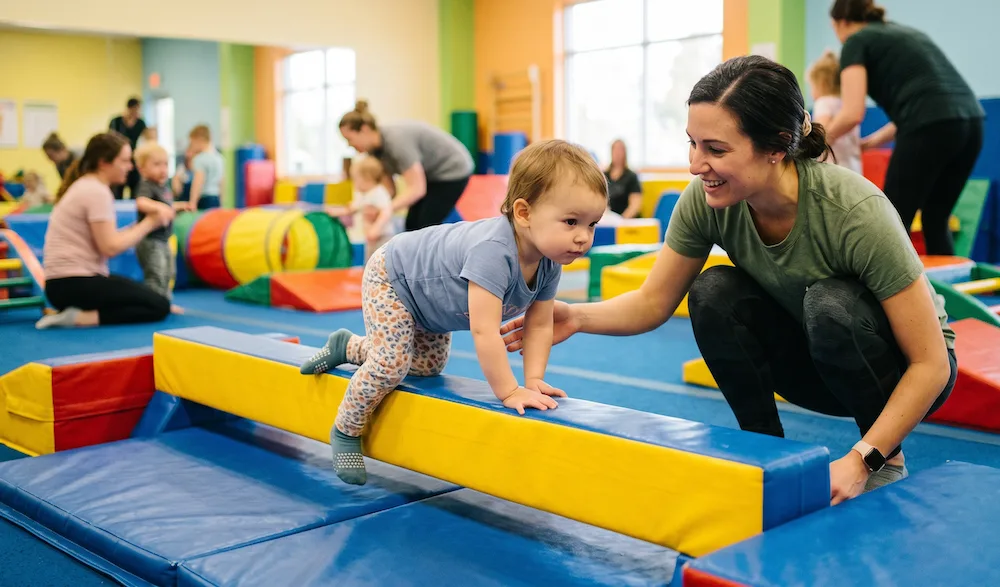
At this age, a gymnastics class is movement play with structure. Nothing more.
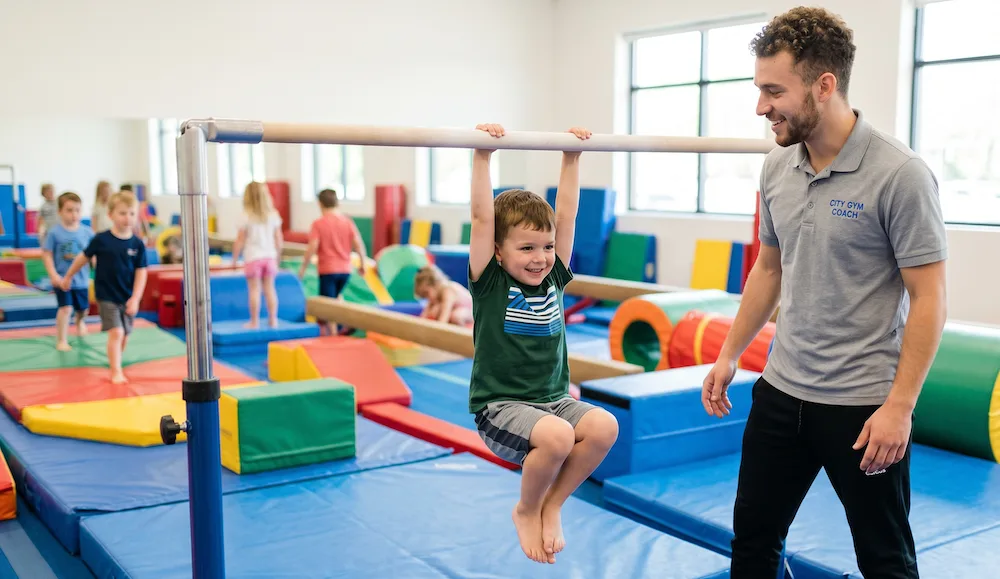
Children roll across mats, crawl through tunnels, balance on low foam beams, swing on low bars and jump into pit foam. These activities are not arbitrary. Crawling stimulates cross-patterning in the brain — the same bilateral movement pattern that supports reading readiness. Swinging on a bar activates the vestibular system, which governs balance and spatial orientation. A parent or carer participates alongside the child throughout. The session is about joy, not technique.
What children gain at this stage: gross motor confidence, vestibular development, social exposure and — critically — a positive relationship with physical challenge. Getting this right now makes every subsequent stage easier.
The parent moves to the sideline. The child joins a group.
This is a significant shift. Children aged 4 and 5 can follow multi-step instructions, tolerate brief waiting periods and begin to understand cause and effect in physical movement. Simple gymnastics skills — forward rolls, straight jumps, balance holds, basic bar hangs — become achievable with coaching support. Sessions rotate through stations: floor, beam, vault run-up, bar and sometimes a trampoline.
This is the stage when gymnastics shifts from movement exploration to genuine skill development. Children this age are also in a critical social window: working with peers in a group, taking turns, responding to a coach’s praise and correction for the first time without a parent mediating.
Something changes between ages 6 and 8. Coordination becomes more reliable.
Children in this range can attempt cartwheels, handstands, backward rolls, and beam walking with growing consistency. They remember skill sequences across weeks. They begin to notice their own improvement — and that noticing builds the intrinsic motivation that keeps them coming back. Recreational gymnastics at this age runs weekly for 45 to 60 minutes. Skills build term over term. Most children in this age bracket have a favourite apparatus within their first month.
The research supports what coaches observe: children aged 6 to 8 show some of the strongest responsiveness to structured gymnastics programs, particularly in coordination and balance outcomes (Australian Sports Commission, Long-Term Athlete Development Framework).
Starting gymnastics at 9 is not starting late. It is starting differently.
Older children learn foundational skills faster than toddlers do in the early weeks. Their bodies are stronger. Their brains process instructions with greater speed and retention. They can also set personal goals — “I want to land a cartwheel this term” — and work toward them with purpose. Senior recreational programs for ages 9 to 12 focus on consolidating technique, building strength progressions and developing the kind of physical confidence that crosses over to every other sport and physical activity in their life.
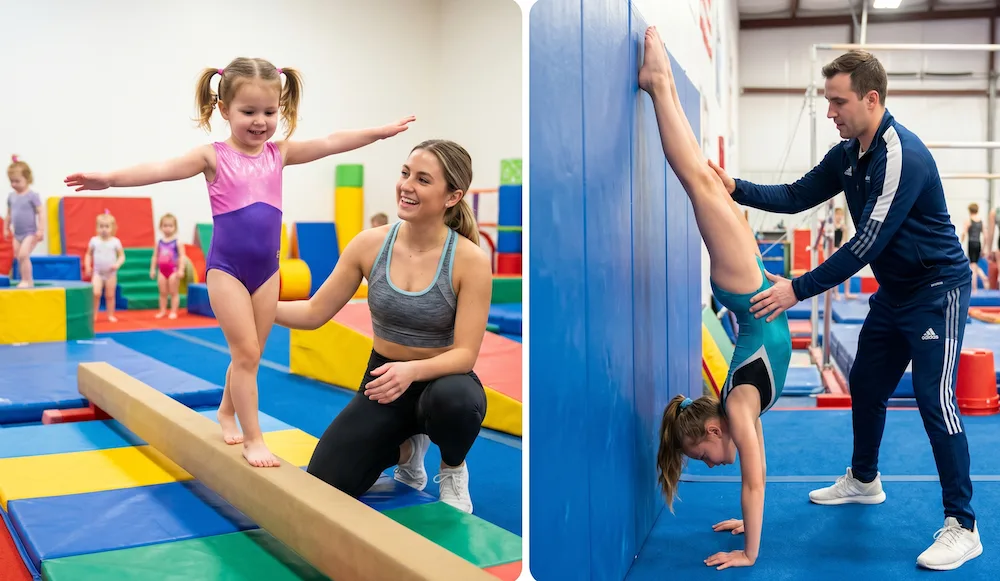
A typical first gymnastics class runs 45 to 60 minutes and follows three phases: a warm-up game, a station rotation, and a group close. Children do not watch demonstrations for long. They move from the first minute. A good class feels active, structured and positive — not regimented or performance-focused.
Every class begins with movement — not stretching.
Coaches use games: follow-the-leader circuits, animal walks, freeze games or obstacle trails. These warm the body and — more importantly for new children — break the ice. A nervous child who arrived clutching their parent’s hand is often running within five minutes. The warm-up signals that this is a safe, fun space. It sets the tone for everything that follows.
Children rotate through four to six activity stations in small groups.
Each station targets a different skill area: floor tumbling (rolls, jumps, balances), the low beam, the bar, a vault approach, and sometimes trampoline or a foam pit. At each station, a coach provides direct instruction and physical spotting where needed. Children attempt skills at their own level. No child is asked to perform something they are not ready for.
The rotation format keeps attention engaged. No child waits more than a few minutes between active attempts. This structure is deliberate — it matches the attention spans of children aged 2 to 12 more accurately than a single prolonged activity would.
The last five minutes bring the group back together.
Coaches typically use a cool-down game, a stretching activity framed as play, or a brief recap of skills attempted during the session. For young children, this ending ritual provides a predictable close that reduces anxiety about “what happens next.” For older children, it is a moment of collective reflection — and often the moment when a coach acknowledges individual effort or improvement, which carries disproportionate weight for children who need external validation before building internal motivation.
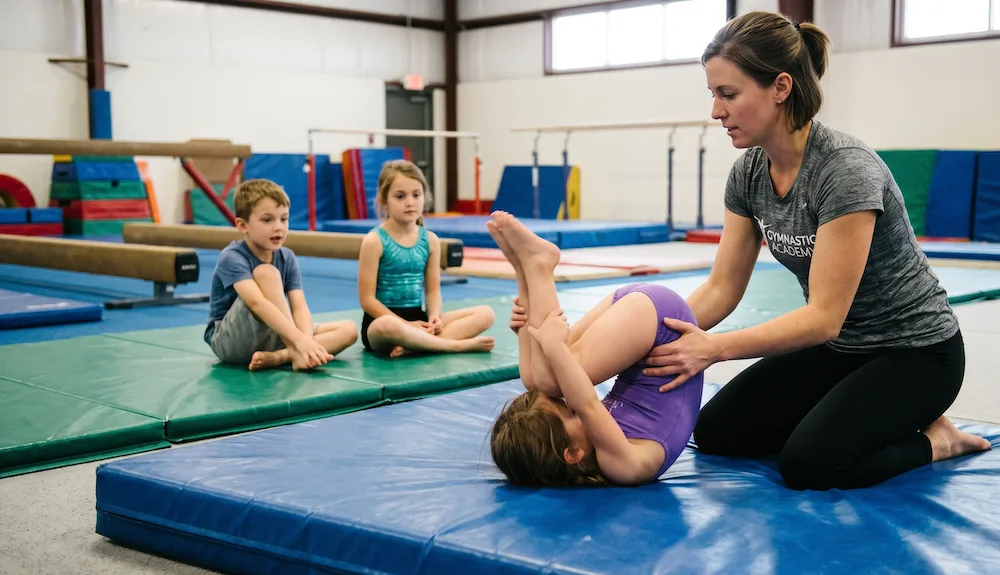
The physical gains from gymnastics are well-known. The cognitive gains are less often discussed — and considerably more interesting.
Gymnastics requires children to constantly read spatial relationships, anticipate movement sequences and adjust timing in real time.
This process — researchers call it motor-cognitive coupling — demands more from the brain than general free play or even most team sports. A child deciding how hard to push off to land a straight jump on a beam is solving a physics problem with their body. A 2024 randomised controlled trial published in the journal Children (University of Novi Sad, NIH-registered) found that developmental gymnastics produced significant improvements in both locomotor and object control skills, with cognitive-motor benefits extending beyond what standard physical education delivered.
Swinging, rolling, spinning, balancing — all gymnastics fundamentals — directly stimulate the vestibular system.
The vestibular system, housed in the inner ear, governs balance, spatial orientation and body awareness. It also connects to the visual processing and language centres of the brain. Gymnastics NSW notes specifically that swinging on a bar activates the vestibular system in ways that improve balance and spatial orientation — the very skills that later support a child’s ability to track text on a page, sit still in a classroom and move confidently in group environments.
No checklist exists that predicts gymnastics success. But five signs suggest a child will settle in quickly.
They enjoy climbing, jumping or rolling at home — unprompted. They can follow two-step instructions without significant prompting (“put your shoes on and wait at the door”). They can cope with a novel environment without extended distress. They show some interest in movement-based television or watching other children move. And they can participate in a group activity — even loosely — without requiring one-to-one adult supervision throughout.
If your child shows three or more of these, they are almost certainly ready for a beginner gymnastics class. If they show fewer, a parent-participation KinderGym format is the better starting point — it removes the separation anxiety variable and lets them build confidence with you alongside them.
Myth 1: My child needs to be flexible first. Flexibility is what gymnastics builds. Children do not arrive flexible and ready — they develop flexibility through consistent practice. The youngest children in recreational programs are typically the most naturally flexible because flexibility peaks in early childhood and decreases with age if not maintained. Starting early preserves it.
Myth 2: If they haven’t started by age 5, it’s too late. Recreational gymnastics programs across Sydney accept new participants at every age from toddlers through teens. Children who begin at 8, 9 or 10 progress rapidly in the early months because their cognitive and physical development gives them advantages toddlers do not have. There is no closed window in non-competitive gymnastics.
Myth 3: Gymnastics is too dangerous for young children. Structured gymnastics classes in accredited centres have strong safety records. All skills are taught progressively. Coaches physically spot new attempts. Equipment is age-appropriate and padded. The risk profile of recreational gymnastics is far lower than contact team sports — and far lower than the risk a child faces tumbling unsupervised off furniture at home.
Myth 4: My child is too energetic and won’t sit still. High-energy children often thrive in gymnastics faster than calmer children. The program is designed for movement — not seated compliance. The station rotation format gives children an outlet for physical energy every few minutes. Many children who struggle to sit through preschool circle time are the most engaged gymnasts in the room.
Myth 5: Gymnastics is mainly for girls. Gymnastics Australia runs structured programs for boys and girls from toddlers through to adults. Boys’ gymnastics develops power, strength, body control and risk management in ways that complement every contact sport. Boys who do recreational gymnastics before age 10 consistently demonstrate better athletic outcomes across multiple sports in adolescence.
Keep it simple. Fitted clothing — leggings and a T-shirt or a fitted top and shorts — works for all ages. Avoid anything with zippers, buttons, belts or large pockets. Gymnastics is barefoot, so shoes stay outside the gym floor. Hair must be tied back — a low bun or secure ponytail, not a top knot that interferes with rolling and beam work.
Bring a labelled water bottle. Nothing else is needed for a first session.
For toddlers in KinderGym, a spare change of clothes in the bag is sensible — active sessions and accidents go together at this age.
Before the class, have one brief conversation with your child. Tell them: “You’re going to move around, try some fun things, and a coach will help you. You don’t have to be perfect — you just have to try.” Then let the coach take it from there. Parents who over-coach from the sideline often slow their child’s adjustment. Step back, observe and celebrate what you see.
For families across Western Sydney — Blacktown, Rooty Hill, Quakers Hill, Penrith and surrounding suburbs — KidsFun at 58 Melanie Street, Hassall Grove NSW 2761 runs structured gymnastics classes for children aged 2 to 12 within a broader all-in-one activity program.
Every coach holds a current Working With Children Check. Group sizes are small. Sessions progress term-to-term with a defined curriculum — children build on what they learned the previous term rather than repeating the same rotation indefinitely. For families who want to add breadth alongside gymnastics, KidsFun’s program also includes kids yoga, music and movement and multi-sport sessions — all under one roof, open daily from 9:30am to 5:30pm.
If your child’s birthday is coming up, KidsFun’s party packages can incorporate gymnastics activities into the celebration — an option that gives the birthday child and their guests an active, structured experience rather than two hours of unmanaged play.
Book online or call +61 426 074 030. If you are still comparing options, our full guide to indoor activities for kids in Sydney covers gymnastics alongside every other major activity category.
National Institutes of Health (PMC) / University of Novi Sad — Developmental Gymnastics RCT (2024) — Peer-reviewed randomised controlled trial with 300 preschool children; confirms two structured gymnastics sessions per week produce significant gross motor skill improvements. pmc.ncbi.nlm.nih.gov
Gymnastics NSW — KinderGym and Recreational Program Guidelines — State governing body guidance on age-appropriate program structures, starting ages and KinderGym development philosophy. gymnastics.org.au
Australian Sports Commission — Long-Term Athlete Development Framework — Evidence base for early sport diversification, age-appropriate physical skill development and the developmental sequence for childhood physical literacy. ausport.gov.au
Internal links:
Can a 2-year-old do gymnastics in Sydney? Yes. KinderGym-style classes in Sydney accept children from 18 months old. At age 2, classes are parent-and-child format — both participate together. The focus is on movement exploration: rolling, balancing, climbing and swinging in a safe, padded environment. No technique is taught or expected. The goal at this age is building a positive relationship with physical movement, which is the single most valuable foundation for all future physical development.
How long before my child learns a cartwheel? This depends almost entirely on the child, not the program. Some children attempt a recognisable cartwheel within two terms. Others take a year. The cartwheel is a complex multi-step movement requiring simultaneous coordination of arm push, hip flexion, leg sweep and landing — it is genuinely difficult. The milestone worth watching instead is confidence: a child who moves toward apparatus without hesitation and attempts new skills without needing repeated encouragement is progressing well, cartwheel or not.
My child cried at the first class. Should I keep going? In most cases, yes. One session is not enough data to judge. Many children cry at the first class — new environment, unfamiliar adults, separation from a parent — and are enthusiastic about returning by session three or four once the format becomes familiar. The exception: if your child’s distress is severe across four or more sessions and shows no downward trend, discuss with the centre whether a parent-participation format or a different class time might reduce the anxiety trigger.
Does gymnastics help with school readiness? Significantly. The bilateral movement patterns in gymnastics — cross-body crawling, rolling, swinging — directly stimulate the cross-patterning brain function associated with reading and writing. Gymnastics also builds attention to instruction, turn-taking, group participation and the ability to attempt something, fail and try again — all core school readiness behaviours. Gymnastics NSW specifically cites school readiness as a documented outcome of KinderGym participation.
Is the Active Kids voucher accepted for gymnastics in Sydney? The NSW Active Kids Program ($50 per child per year) is redeemable at registered gymnastics providers. Registration varies by centre. Contact KidsFun directly on +61 426 074 030 or check your chosen venue’s website to confirm current Active Kids registration before booking. Many multi-activity centres across Western Sydney are registered providers.
Do boys benefit from gymnastics as much as girls? Yes — and in some areas, more so. Boys’ gymnastics emphasises upper body strength, power, controlled risk-taking and body discipline in ways that directly complement football, cricket, swimming and most other sports boys participate in. Children who do recreational gymnastics before age 10 — regardless of gender — demonstrate superior athletic development outcomes compared to age-matched peers who specialised in a single sport early (Australian Sports Commission, Long-Term Athlete Development Framework).
How often should my child attend gymnastics classes? For recreational gymnastics, one session per week is the standard and is sufficient for meaningful developmental gains. The 2024 NIH-registered trial that studied preschool gymnastics outcomes used two sessions per week and produced significant results — but one well-structured session weekly delivered within a quality program with progressive curriculum produces strong outcomes for non-competitive participants. Consistency across a full term matters more than session frequency.
The question parents most often regret is not “Did I start too early?” It is “Why did I wait so long?” Gymnastics for kids does not require a perfectly coordinated child. It does not require flexibility, fearlessness or a particular body type. It requires a child who is curious, a venue with qualified coaches and a parent who is willing to step back and let the process work.
If you are in Western Sydney and ready to see what that first session looks like, KidsFun at Hassall Grove runs daily programs for children aged 2 to 12. Book online — or call the team on +61 426 074 030 if you want to discuss which class suits your child’s age and stage before committing. And if you are still deciding between gymnastics and something else entirely, explore our complete guide to Sydney’s best indoor kids activities — it covers the full picture.
