
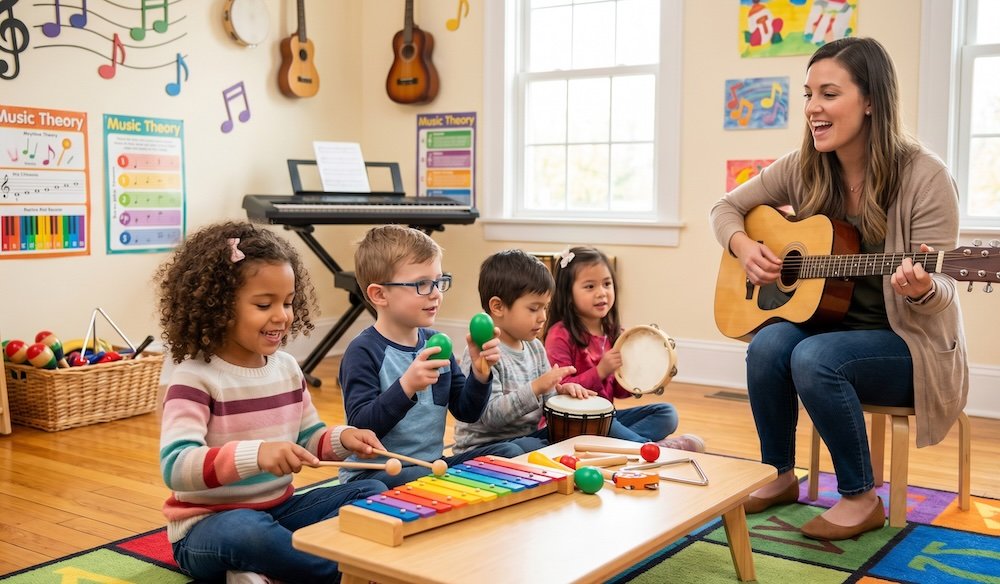
Music classes for kids in Sydney are everywhere. Mini Maestros, Einsteinz, Ukubebe, the Sydney Conservatorium’s Open Academy — the options exist. What most parents struggle to find is a clear answer to the question underneath the search: does music actually do what people say it does, and is it right for my child?
The answer, backed by a consistent body of neuroscience research, is more impressive than most activity marketing suggests. Music activates more of the human brain simultaneously than virtually any other activity. It engages auditory processing, motor coordination, emotional regulation, memory and language — all at once. Australia’s Department of Education Learning Potential resource notes directly that musical activities stimulate the brain, building new neural connections that improve language development, reading readiness and reasoning (Learning Potential, Australian Government, 2024).
This guide cuts through the program marketing. It covers the science plainly, explains what to look for in a quality class, and helps Sydney parents — particularly those in Western Sydney — make a confident decision before the next term enrolment opens.
Most children’s activities develop one system at a time. Sport builds motor skills. Art builds creativity. Music builds everything simultaneously.
When a child claps a rhythm, their brain fires motor, auditory and timing networks together. When they sing a lyric, language processing runs in parallel with memory and breath control. When they play an instrument in a group, they read social cues, listen for cues from others and self-regulate — all within a single bar of music.
Neurologists point to the corpus callosum — the band of tissue connecting the brain’s two hemispheres — as a key site of music’s impact. Musical training actively strengthens this connection. A stronger corpus callosum improves problem-solving, emotional resilience and the speed of information transfer across the brain. No other children’s activity produces this specific neurological outcome as consistently as music.
The practical result: children who receive regular music education tend to outperform peers in language, reading, mathematics and executive function. These are not theoretical benefits. They show up in classroom performance, teacher observation and longitudinal studies across multiple countries.
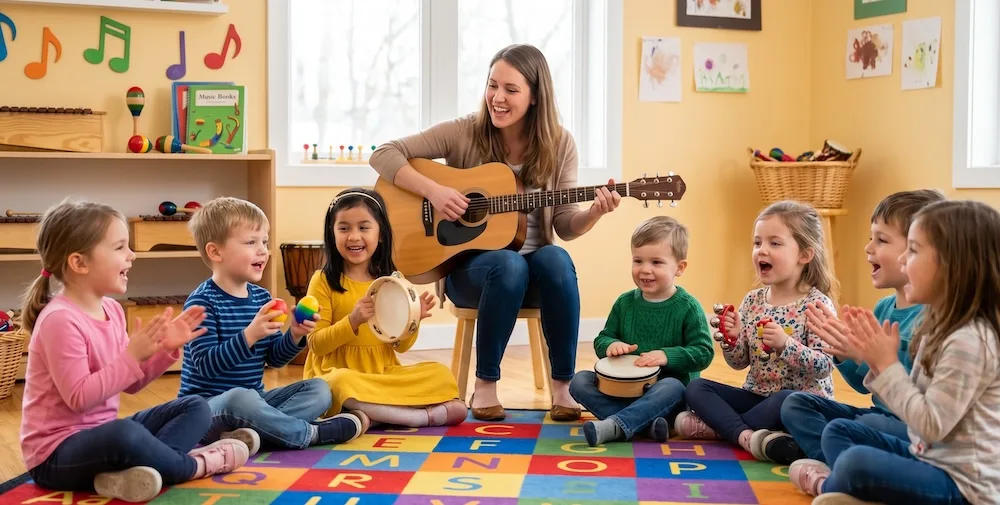
Music classes for young children build cognitive, social and emotional skills at a rate no other single activity matches. Specifically: they improve verbal memory, accelerate language acquisition, strengthen reading readiness, develop fine motor coordination, build confidence in group settings, and support emotional regulation. Research published in the journal Frontiers in Psychology (2021) found that children with musical training showed significantly enhanced linguistic skills — including vocabulary and reading comprehension — compared to peers without music education.
Music trains the brain to recognise patterns. This matters enormously for mathematics, language and logical reasoning.
Children who learn rhythm and beat develop an internal sense of timing and structure. This same cognitive scaffolding supports reading comprehension and number sense. The Australian Government’s Learning Potential resource confirms that music helps develop the left hemisphere of the brain — the side responsible for language and reasoning — and teaches children to distinguish sounds, which directly supports phonemic awareness and early literacy.
Group music is non-competitive. Every child contributes. No child fails.
This makes it powerful for building confidence, particularly in children who do not thrive in competitive environments. Taking turns, listening to others, responding to a shared beat — these are social skills practised in every session. Children develop patience, group awareness and the ability to express emotion through sound. Many parents find that music is the first activity where a shy child genuinely relaxes.
Instrument play builds fine motor control in ways that most structured activity cannot replicate.
For toddlers, shaking a maraca or tapping a drum develops grip, coordination and bilateral movement. For older children, keyboard or guitar play refines finger independence and hand-eye coordination. Combined with movement — clapping, stomping, swaying — music sessions give young children a full-body developmental workout dressed as pure fun.
Children can start music programs from as young as six months old. The most significant window for early childhood music development is from birth to age five, when brain plasticity is at its highest. However, structured instrument exploration and group music classes remain highly beneficial at any age up to 12 and beyond. There is no “too late” in recreational music education.
At this age, the class is about experience — not technique.
Sessions combine singing, instrument exploration, clapping, stomping and dancing. A child aged 2 or 3 does not need to hold a correct grip or read a beat. They need repeated, joyful exposure to sound, rhythm and movement. Many programs at this age are parent-and-child format, which means the bonding element is built directly into the session structure.
Children in this range can follow multi-step instructions. They retain melodies. They start to understand rhythm patterns.
This is when structured music programs gain real traction. Children begin to connect what they hear to what they do — clapping a rhythm, singing a tune in time, responding to a conductor’s cue. Instrument rotation is common at this stage: sessions introduce percussion, keyboards and simple stringed instruments before a child commits to learning one in depth.
Older children learn faster once they begin. Their cognitive processing is stronger. Their fine motor control is more developed.
At this age, music education can shift toward individual instrument study if the child shows interest. Group ensemble work — playing together as a band or choir — is also developmentally excellent: it builds teamwork, listening and leadership alongside the musical skill itself.
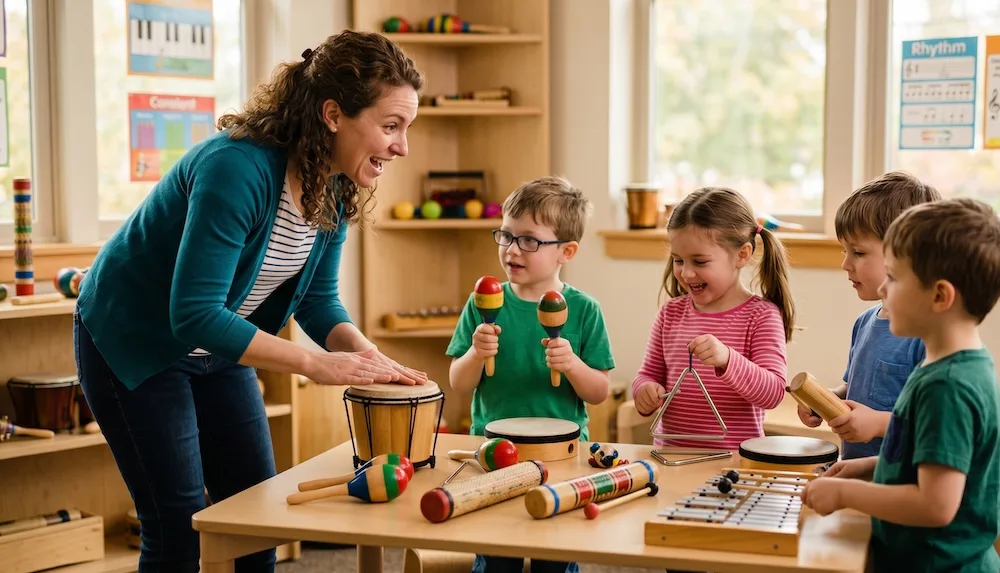
Sydney offers four main types of music classes for children: music and movement programs (ages 0–5), group recreational programs (ages 3–10), instrument-specific lessons, and multi-activity sessions that integrate music into a broader program. Each suits different ages, goals and family schedules.
Music and movement programs — like Kindermusik, Mini Maestros and Einsteinz — suit toddlers and preschoolers. They are parent-inclusive, sensory-rich and designed for early brain development rather than musical performance.
Group recreational programs — including Kids at the Con at the Sydney Conservatorium — target children aged 3 to 10 and focus on creative music-making, singing, percussion and movement in small groups. They are non-competitive and curriculum-based.
Instrument lessons — piano, guitar, violin, drums — are typically appropriate from age 4 or 5 upward and can be private or group-format. These suit children who have already developed interest and attention span.
Multi-activity centres — like KidsFun at Hassall Grove — integrate music into a broader weekly program alongside gymnastics, yoga and sports. This suits families who want developmental variety without managing multiple venue relationships across the week.
Yes — consistently and significantly. Children who receive regular music education show measurably stronger language and reading skills than peers without music exposure. The connection is neurological: music trains the brain to distinguish sounds, recognise patterns and process rhythmic sequences — all of which are foundational skills for phonics, reading fluency and vocabulary development.
Research reviewed by the National Institutes of Health (PMC, 2014) found that children with musical training demonstrated better verbal memory, improved second-language pronunciation, stronger reading ability and enhanced executive function. These gains were not marginal. They were consistent across multiple studies and age groups.
The mechanism is straightforward. Learning a song involves hearing phonemes in sequence, reproducing them accurately and timing each syllable to a beat. This is essentially a sophisticated phonemic awareness exercise dressed as music. Children who do this weekly develop the auditory discrimination skills that underpin reading — without ever opening a textbook.
For Sydney parents concerned about school readiness, early literacy or language delay, a quality music program is not a luxury add-on. It is one of the most evidence-supported interventions available outside of direct speech therapy.
Pairing music with other physical activities amplifies the benefit. If you are already exploring gymnastics or yoga for your child, read our indoor activities guide to see how a multi-activity approach can compound developmental gains across a single term.
The quality of a kids music class in Sydney depends almost entirely on the instructor — not the program name, the instrument list or the venue location. A great music educator for young children creates an environment where every child feels safe to make noise, attempt something new and occasionally get it wrong. A poor one enforces silence, corrects without encouragement, and turns music into a source of performance anxiety before a child is ten.
Watch the first session closely. A strong children’s music instructor leads with energy and warmth. They use games and movement to teach rhythm before they teach notation. They make eye contact with individual children. They respond to the group’s energy — faster, slower, louder, quieter — rather than following a rigid script.
Ask directly: “What qualifications does your instructor hold?” In NSW, all adults working with children must hold a current Working With Children Check. Music educators working in early childhood settings should also hold a formal music education qualification — not just performance credentials. A trained performer and a trained music educator for children are very different roles.
The best music classes for young children are active. Children sing, play, move, clap and respond. They are not an audience.
Avoid programs where children sit and listen to an instructor perform. Passive exposure has some benefit — but it is a fraction of what active participation delivers. The research is clear: children who produce music develop faster, across more cognitive domains, than children who only consume it.
For ages 2 to 5, a maximum of ten to twelve children per instructor is appropriate.
Larger groups make it harder for instructors to monitor individual engagement, respond to hesitant children, or provide the one-to-one micro-moments that build a young child’s confidence. For ages 6 and above in structured group programs, slightly larger groups can work well — but anything above fifteen children per instructor starts to reduce the individual benefit.
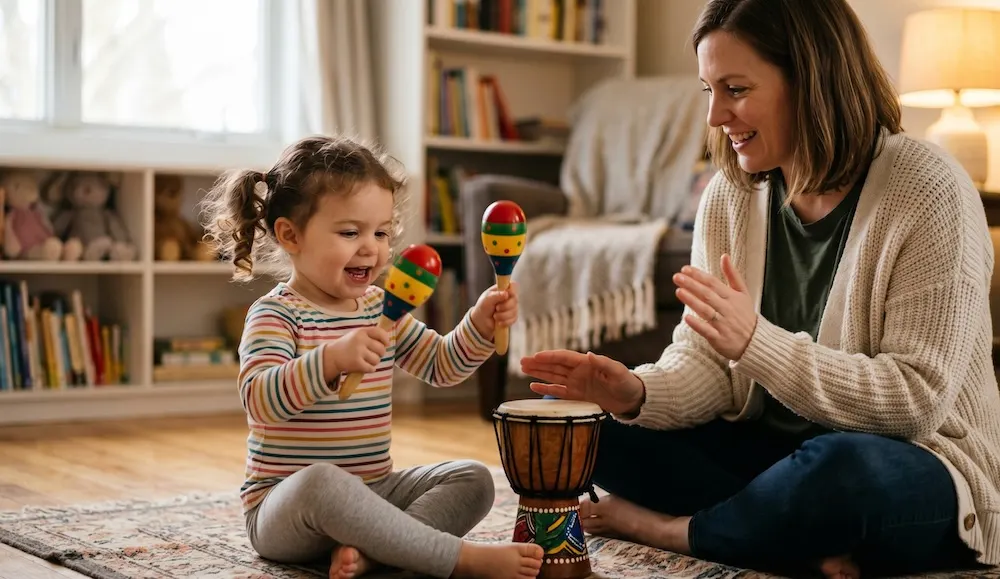
For Western Sydney families — including those in Blacktown, Quakers Hill, Rooty Hill, Penrith and surrounds — accessing quality music education without commuting to the inner city has historically been difficult. Most established programs operate in the Eastern Suburbs, North Shore or CBD.
KidsFun at 58 Melanie Street, Hassall Grove NSW 2761 runs music and movement classes for children aged 2 to 12 as part of its all-in-one activity program. Instructors hold current Working With Children Checks. Classes run in small groups within a structured curriculum that progresses across terms.
The multi-activity model means music sits alongside gymnastics, yoga and sports under one roof. For families juggling two or more children in different programs, this removes the time and cost of managing multiple venues each week. Birthday party packages that include live music entertainment are also available for families looking to tie an activity milestone into a celebration.
KidsFun is open daily from 9:30am to 5:30pm. Book online or call +61 426 074 030 to discuss which music program suits your child’s age and stage.
Australian Government — Learning Potential — Cites neuroscience research on music’s effect on brain development, language acquisition and reading readiness in children. learningpotential.gov.au
National Institutes of Health (PMC) — Musical Training and Cognitive Development Review (2014) — Peer-reviewed synthesis of research confirming music training’s benefits for verbal memory, reading ability, second-language skills and executive function in children. pmc.ncbi.nlm.nih.gov
Frontiers in Psychology (2021) — Study finding that children with musical training show enhanced linguistic skills including vocabulary and reading comprehension compared to children without music education.
Internal links:
How much do kids music classes cost in Sydney? Early childhood music programs (ages 0–5) in Sydney typically cost between $19 and $30 per session when enrolled by school term. Group recreational programs for ages 3–10 range from $20 to $35 per session, with term fees between $150 and $300. Multi-activity centres that include music as part of a broader program may offer lower per-session rates through combined or membership pricing. NSW families should also check eligibility for the Creative Kids Voucher ($50 per child annually) at registered providers.
Is music education covered by the Creative Kids Voucher in NSW? Yes. The NSW Creative Kids Program provides a $50 voucher per eligible child per year, redeemable at registered activity providers that include music education. Many music programs and multi-activity centres in Sydney are registered providers. Contact your chosen venue directly to confirm registration before booking — KidsFun can be reached on +61 426 074 030.
Do music classes help children with speech delays? Music-based programs are widely used as a complement to speech therapy for children with language delays. The rhythmic, repetitive and sound-rich nature of music sessions builds phonological awareness — the ability to hear and manipulate sounds — which is one of the core foundations of speech and language development. Parents who have concerns about a child’s language development should speak with a paediatric speech pathologist directly, but music classes are a well-supported supplementary activity.
Can introverted or shy children do well in group music classes? Group music is one of the best environments for shy children. Every child contributes, and no child is singled out or judged. The shared rhythm and collective sound give shy children permission to participate without performing — clapping along, shaking a maraca, singing quietly — before they feel confident enough to engage more fully. Many parents of introverted children report that music class is the one activity their child asks to return to without prompting.
What instrument should my child start with? For children aged 2 to 5, instrument-specific learning is premature — what matters is broad instrument exposure through percussion (drums, maracas, xylophones) and singing. From age 5 upward, common beginner instruments are keyboard/piano (develops reading music and finger coordination), ukulele (small size, soft strings, easy chords) and drums (excellent for children with high physical energy). The child’s interest and the instrument’s physical appropriateness for their size and coordination should drive the choice, not parental preference.
How do I know if a music class is genuinely educational or just entertainment? Ask the provider two questions: “What does my child work toward across a full term?” and “How do your instructors’ qualifications extend beyond music performance?” A genuine educational music program has a curriculum — a planned sequence of skills and experiences — not just a playlist. Instructors should hold early childhood music education credentials in addition to performance background. Entertainment-only programs are enjoyable but do not build the developmental outcomes that research-backed, curriculum-structured programs consistently deliver.
How is music and movement different from instrument lessons? Music and movement programs — typically for ages 0 to 5 — use singing, percussion, body movement and listening to develop overall early brain development and motor skills. They do not focus on learning a specific instrument. Instrument lessons — appropriate from around age 4 or 5 — focus on technique, reading music and developing proficiency on a specific instrument. Both are valuable. Most early childhood specialists recommend music and movement programs first, with instrument study following when a child shows focused interest.
Every term that passes without music is, in a very real neurological sense, a term of slower brain development. That sounds dramatic — but the research is that clear. Music does not merely entertain children. It builds the architecture of cognition that shapes how they learn, communicate, socialise and regulate themselves for the rest of their lives.
If you are in Western Sydney and ready to find the right program, KidsFun at Hassall Grove runs music classes daily for children aged 2 to 12. Online booking takes under two minutes. Or explore our full guide to the best indoor activities for kids in Sydney — and find the complete combination that works for your family. Drop a question in the comments if you are still deciding which activity type fits your child best. We read every one.